

by Nicki Thomson, Senior Director of Research & Learning, and Grace Bramman, Director of Evaluation & Grants
Special acknowledgment to Xinchang Zhou, University of Illinois Urbana-Champaign, for data analysis support on this project.
What helps teens thrive? The answer starts with connection and belonging. Experts in the field all agree – young people need more opportunities to connect with their peers, schools, and communities. Improving social connections for young people has been shown to improve mental health, increase academic engagement, and positively impact long-term physical health.
Wyman’s recent national findings show that Teen Connection Project creates supportive spaces where young people connect with one another, experience belonging, and know they matter.
About Wyman’s Teen Connection Project
Wyman’s Teen Connection Project (TCP) is an evidence-based program for high school students focused on helping teens build stronger connections with peers, strengthen social and emotional skills, and develop a greater sense of well-being. TCP is delivered in small groups by trained facilitators, using a 12-lesson curriculum focused on communication, trust, vulnerability, giving and receiving support, and recognizing personal and peer strengths.
The current project analyzed data aggregated across three program years (2022-2023, 2023-2024, and 2024-2025) to better understand what teens report gaining from TCP and how program quality and facilitator relationships relate to outcomes. These analyses were conducted as part of Wyman’s ongoing learning and continuous improvement approach using teens’ responses on the TCP Teen Survey and participation data submitted by national TCP implementation sites.
Our Study Approach
We explored data collected by national TCP implementation sites to better understand the benefits of TCP for participating teens, and whether outcomes are linked to program quality and completion of the full program. Specifically, we explored the following questions:
- Do teens experience positive outcomes in TCP?
- Are positive outcomes linked to teens’ program experiences, including relationships with facilitators or quality of the program environment?
- Are positive outcomes linked to amount of program participation?
Who Participated
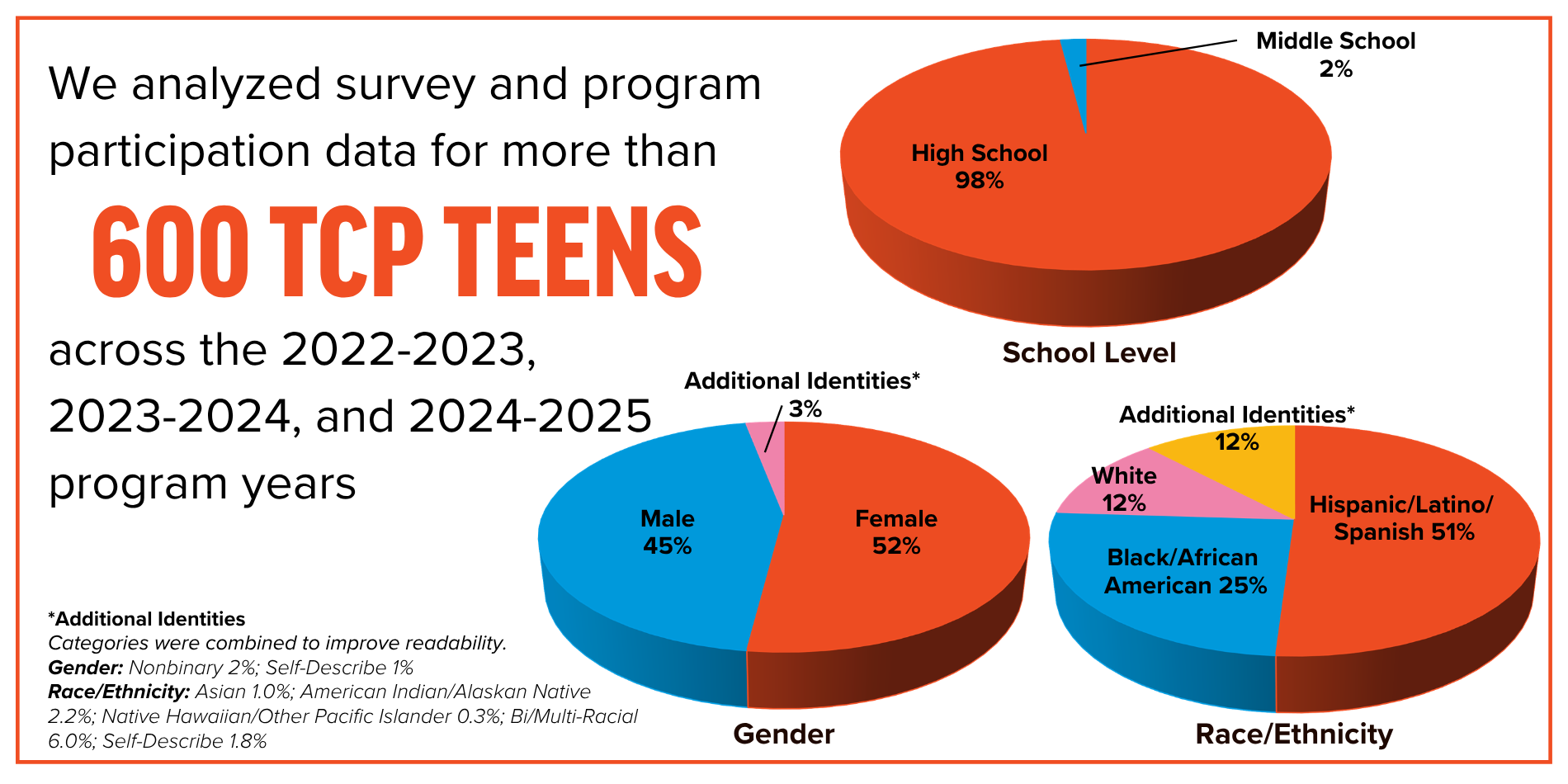
We analyzed combined teen survey and program participation data from program years 2022-2023, 2023-2024, and 2024-2025, with data from more than 600 total teens representing 10 national replication partners, including Wyman.
- Over half of the teens identified as female (52%).
- The largest racial/ethnic group identified, representing over half of the sample (51%), was Hispanic/Latino/a/x.
- 98% of teens were in high school (9th, 10th, 11th, and 12th grade).
What We Measured
Outcomes and program quality were measured using the TCP Teen Survey. This survey has been used nationally by organizations implementing TCP since the 2021-2022 program year and gathers basic demographic information along with data on social coping skills, peer relationship quality, school belonging, friendship, social-emotional skills, overall well-being, and loneliness. Teens completed the TCP Teen Survey at the end of the program. The survey asked them to reflect back and rate their skills and relationships before participating in TCP and then again after completing the program, all within a single survey administration. This approach supports understanding of changes in how teens perceive their skills, relationships, and well-being. The survey also gathers teens’ input on their program experiences, including measurement of facilitator relationship and program environment quality.
Each TCP Group collects and submits data on each instance a TCP meeting was held and each TCP Curriculum lesson that was delivered. Teens who were members of a group that offered all 12 Curriculum lessons and attended at least 9 meetings are considered to have received “full dosage” of TCP.
What We Learned
Teens participating in TCP reported positive changes in outcomes including growth in their social-emotional skills. A high-quality program environment emerged as an important factor linked to all outcome areas, while positive relationships with facilitators were linked to positive results in some outcome areas. Program dosage was not found to be linked to outcomes, but this finding comes with some limitations.
TCP Teens Reported Improvements in Key Skills, Relationships, and Well-Being
Across the national sample, teens reported improvements in:
- Social Coping (using social support to help deal with challenges)
- Peer Relationships (feeling trusting and comfortable with others)
- School Belonging (feeling included and engaged at school)
- Friendships (having healthy and supportive friendships)
- Social-Emotional Learning (skills in empathy, communication, self-efficacy, self-esteem)
- Well-Being (feeling healthy and hopeful about the future)
- Loneliness (feeling distant or misunderstood by others)
Patterns of improvement were similar across race, gender, and grade level groups represented in the data, suggesting TCP may be beneficial across diverse groups of participating teens.
Facilitator Relationships & High Quality Program Environment Matter
Teens who experience positive relationships with their TCP facilitators and a higher quality program environment (i.e. feelings of safety and belonging in TCP) were more likely to report improvements in their skills, attitudes, and behaviors. The following outcome areas were shown to be associated with teens’ program experiences:
- Social Coping (facilitator and program environment quality)
- Peer Relationships (program environment quality only)
- School Belonging (program environment quality only)
- Friendships (facilitator and program environment quality)
- Social-Emotional Learning (facilitator and program environment quality)
- Well-Being (program environment quality only)
- Loneliness (program environment quality only)
Limited Learning About Program Dosage
TCP teens who received the full program dosage (were members of a group that offered all 12 lessons and attended at least 9 sessions) were no more likely to report stronger outcomes than teens who did not receive full program dosage. However, because the vast majority of participants (78%) met the criteria for full dosage, there was limited variation in participation levels, therefore this analysis may not fully capture how differences in attendance relate to outcomes.
Teens Value Relationships as the Foundation of TCP
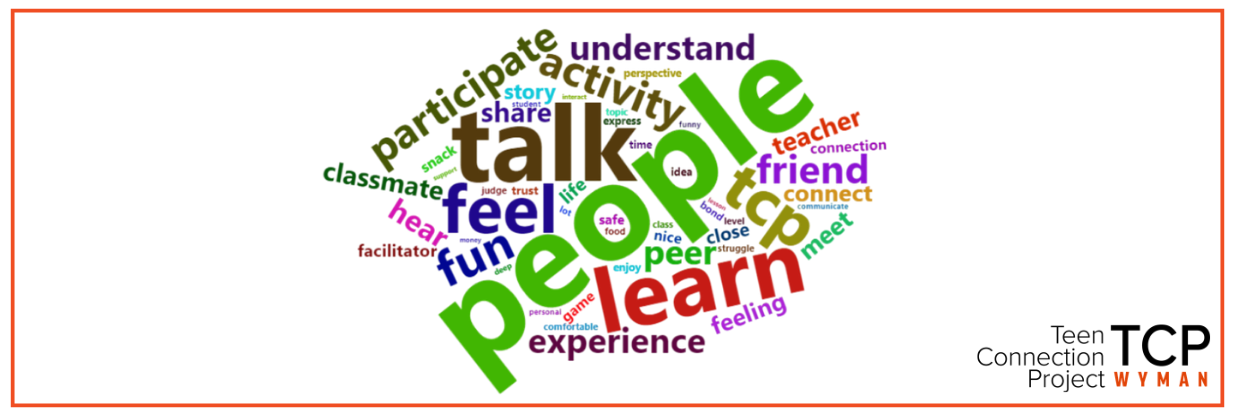
The below word cloud summarizes teens’ answers to the open-ended survey question “what has been the best part about participating in TCP?” These responses help illustrate in teens’ own words the aspects of TCP they found most meaningful. Themes reveal a strong emphasis on interpersonal connection and emotional engagement – two of the centerpieces of TCP’s programmatic model.
Key Takeaways
This analysis offers insight into how TCP is experienced by teens across diverse implementation settings. Teens reported growth in key outcome areas such as social coping, peer relationships, school belonging, social-emotional skills and overall well-being. The findings also highlight the importance of creating high-quality environments where teens feel safe, connected and supported by peers and facilitators. Together with prior research conducted on the TCP program model (Allen et al., 2020), these results contribute to Wyman’s ongoing learning about how TCP supports positive youth development and meaningful social connection. In the broader landscape of positive youth development efforts, these findings underscore the value of programs like TCP that intentionally combine social emotional learning, supportive adult and peer relationships, and consistent engagement over time.
What’s Next
These national findings reinforce what we have always known: when young people have opportunities to build meaningful relationships in safe, supportive environments, they are better equipped to thrive. At a time when many young people are seeking connection, belonging, and community, programs like TCP can make a meaningful difference.
We invite you to partner with us to bring TCP to teens in your community. If you’re interested in learning more, complete this form and a member of our team will be in touch.